How can we help?
Annual Tax Statement Components
Jump to:
- Do you have trust income?
- What type of trust investment do you hold?
- Running the Taxable Income Report
- Cost base adjustments
- Why did each distribution amount change at tax time?
At the end of the financial year, your fund manager will issue an Annual Tax Statement (also known as an AMMA or SDS statement). This statement breaks down your yearly income into various tax components such as Capital Gains and Foreign Income. Use this form to enter those totals so Sharesight can automatically attribute them to the correct tax year.
⚠️ You must Save and confirm. Until you save and confirm the distribution, its attributed discounted and other capital gains won't appear in your Capital Gains Tax Report — so your capital gains will be understated compared with the ATO's pre-fill in myTax. This applies whether Sharesight pre-filled the estimated components for you or you entered them manually.
Do you have trust income?
Trust income is income received from an investment structured as a trust. Unlike dividends from shares, trust distributions "pass through" multiple tax components — such as capital gains, foreign income, and cost base adjustments — that you must report separately to the ATO.
You likely have trust income if you hold:
- ETFs (Exchange Traded Funds): Almost all ASX-listed ETFs (e.g., Vanguard, BetaShares).
- Managed Funds: Both unlisted funds and "Active ETFs" (e.g., Loftus Peak).
- Stapled Securities: Investments that bundle a trust and a company together (e.g., Goodman Group, Scentre Group, Transurban).
- Unit Trusts: Property or infrastructure trusts.
You do NOT have trust income if you hold:
- Individual Shares: Companies like CBA, BHP, or Woolworths.
- LICs (Listed Investment Companies): While they look like ETFs, companies like AFIC (AFI) or Argo (ARG) are legally companies. They pay dividends, not trust distributions, and do not require you to enter annual tax components.
The Rule of Thumb: If you receive an Annual Tax Statement (often called an AMMA or SDS statement) at the end of the year, you have trust income and need to complete this process.
What type of trust investment do you hold?
- ETF (ASX-listed) → See ETFs in Sharesight
- Managed fund (unlisted) → See Managed funds AMIT guide
- Stapled security (REIT, infrastructure trust) → See Stapled securities guide
- Unit trust → Jump to How to enter AMIT components below
Running the Taxable Income Report:
1 – From any page click on the 'Tax' tab.

2 – Click the 'Taxable Income Report' tile.
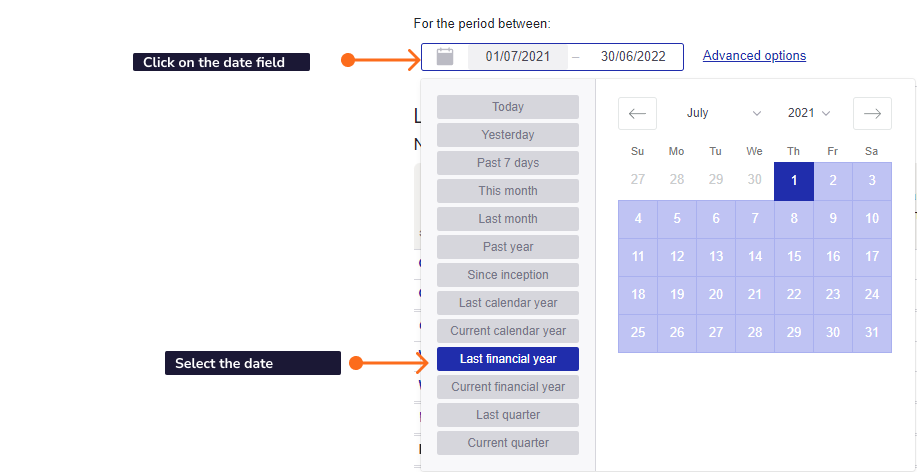
3 – From the dropdown calendar, select the date range you want to run the report in.
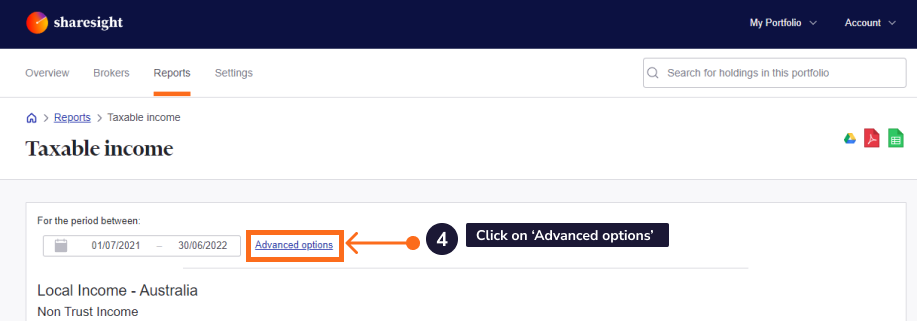
4 – Click 'advanced options' to choose to:
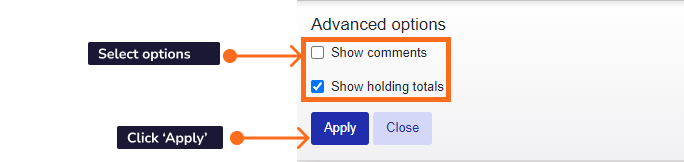
Show Comments - display any comments associated with a dividend or distribution.
Show holding totals - displays dividend or distribution totals across all payouts for a single investment. This is particularly useful for reconciling your Sharesight distribution data with the annual taxation statement you receive at the end of the tax year for each ETF, Managed Fund, or Unit Trust you own. This option needs to be selected to use the Trust pro rata distributions components form.
5 – Click 'Apply'.
Disclaimer: Sharesight does not provide taxation advice and the reports do not constitute personal taxation advice. If you have any questions about your tax position we recommend you contact your accountant or tax advisor. You remain solely responsible for complying with all applicable accounting, tax and other laws.
Additional Resources, watch the using Sharesight to complete your tax return webinar recorded 24 June 2020. Learn how to use Sharesight to make completing your tax return quicker, easier and more accurate by Ben Clendon, Sharesight Product Manager.
Cost base adjustments
When you hold an ETF, managed fund, or other trust investment, your annual tax statement may include components that adjust the cost base of your investment rather than contributing to your taxable income for the year. These appear as line items under the Income section on your individual holding page.
The two types of cost base adjustment:
- AMIT cost base increase — The fund allocated more income to you than it paid out in cash. This increases your cost base, meaning you will have a smaller capital gain (or larger capital loss) when you eventually sell.
- AMIT cost base decrease / Tax deferred amount — The fund distributed more cash than it allocated as taxable income. This decreases your cost base, meaning you will have a larger capital gain when you eventually sell.
What do cost base adjustments affect?
Cost base adjustments do not appear in your CGT Report directly. Instead, they change the cost base of your holding over time. The impact only shows up when you sell the investment — at that point, your capital gain or loss will reflect all accumulated adjustments.
To see your adjusted cost base at any time, run the Historical Cost Report and check the Closing Balance column.
For step-by-step instructions on entering your Annual Tax Statement components, see the dedicated guide for your investment type — starting with ETFs in Sharesight.
Why did each distribution amount change at tax time?
Sometimes, after the finalised tax components replace the estimates — whether Sharesight pushed them through automatically or you entered them from your annual tax statement — the net amount of an individual distribution changes. It doesn't always happen, and where it does the change is often small (sometimes only a few cents). This is expected — here's why.
This can occur with any trust investment that pays more than one distribution a year — ETFs, managed funds, unit trusts and stapled securities alike. When the finalised components come in, Sharesight doesn't just update the annual totals — it re-apportions them back across each distribution: it works out each distribution's ratio of the year's total, then spreads the finalised figures across the distributions using those ratios. Because the finalised numbers differ from the earlier estimates, the split can shift — so one distribution might tick up and another down.
The key point: the total for the financial year stays the same — only how it's allocated across the individual distributions changes. If you reconcile at the yearly level (the sum of all distributions), it will still match your annual tax statement.
Tip: To check the yearly total, run the Taxable Income Report with Show holding totals turned on — it sums all distributions for each holding so you can reconcile against your statement.
Last updated 10th September 2026