How can we help?
Cash account performance
Note: Cash accounts are available on Starter, Standard, Premium and Sharesight Business plans.
Cash balances in bank and broker accounts earn interest, incur fees and, if they are held in a foreign currency, move with exchange rates. All of these affect your overall portfolio position. Sharesight now calculates performance on your cash accounts, so each cash account shows its own return broken down into income and currency gain or loss, and your cash is included in your portfolio's performance and total return. This gives you a more complete, more accurate picture of how your whole portfolio is performing, not just your investments.
Jump to:
Turn on cash account performance
Cash account performance is a per-portfolio setting:
- New retail portfolios have it turned on by default.
- Existing portfolios and new Sharesight Business portfolios have it turned off by default, so you will need to turn it on.
To turn it on:
- Open the portfolio and click the Settings tab.
- In the left-hand menu, under Portfolio, select Cash accounts.
- Under Performance, tick Show cash account performance, then click Apply changes.
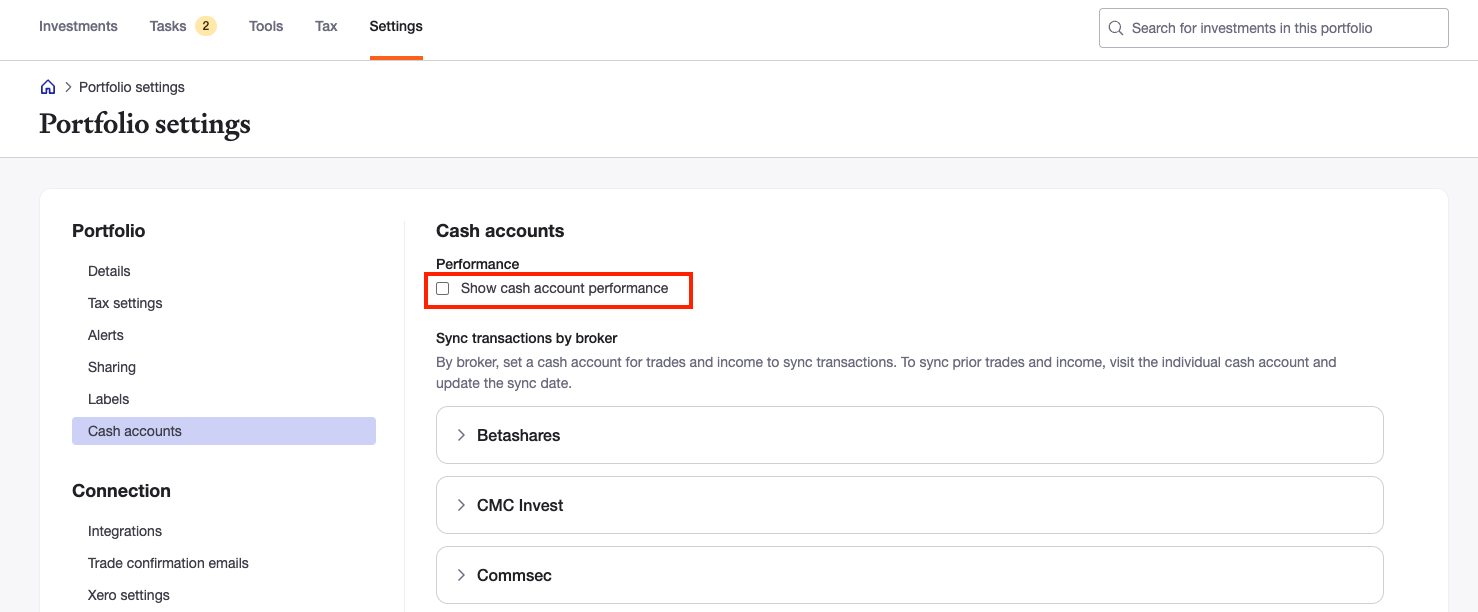
Once it is on, each cash account on the Portfolio Investments page and in your performance reports shows its own return.
Using the Sharesight API? You can also turn this setting on or off with the show_cash_performance parameter on the v2 Create Portfolio and Update Portfolio endpoints.
How the return is calculated
Sharesight calculates the return on a cash account the same way it does for any other holding, splitting it into the standard components of return:
| Component | How it applies to a cash account |
|---|---|
| Capital gain | Always zero. Cash has no unit price, so one dollar is always worth one dollar in its own currency. |
| Income gain/loss | Interest and fee transactions recorded on the cash account (see below). |
| Currency gain/loss | Exchange-rate movement on cash held in a currency different from your portfolio's currency. Zero for cash held in your portfolio's currency. |
| Total return | Income gain/loss plus currency gain/loss. |
Income gain/loss
Income gain/loss is built from the transactions recorded on the cash account:
| Transaction type | Treated as |
|---|---|
| Interest Payment | Income gain |
| Fee Reimbursement | Income gain |
| Fee | Income loss |
| Interest Charged | Income loss |
Deposits and withdrawals are not gains or losses. They are your own money moving in or out of the account, so they do not change the dollar return. They only affect the capital used to calculate the percentage return (see below).
Because Fee transactions count as an income loss, you can record portfolio-level costs, such as an adviser or account management fee that is not tied to a specific holding, as a Fee on a cash account so it is factored into your portfolio's performance.
Currency gain/loss
Currency gain/loss only applies to a cash account held in a currency different from your portfolio's currency, and is calculated separately from income.
Each transaction on the account is converted to your portfolio's currency using the exchange rate on the date the transaction happened. Because the money is still held in the foreign currency, its value in your portfolio's currency keeps changing as exchange rates move. Sharesight revalues each transaction from the exchange rate on its own date to the current exchange rate, and adds these together to give the currency gain or loss for the account.
This means the currency gain/loss on a foreign-currency cash account changes from day to day as exchange rates move, even if no new transactions have been added.
Percentage return
The percentage return uses the same dollar-weighted (money-weighted) methodology Sharesight uses for the rest of your portfolio:
- Total return ÷ average capital invested. Deposits and withdrawals are weighted by how long they were in the account during the reporting period. A deposit or withdrawal made late in the period affects the capital base less than one made at the start.
- Annualising. If the money has been invested for less than a year on average, the return is shown as the actual return for the period and is not annualised. Once it reaches a year or more, the return is annualised using your portfolio's simple or compound calculation setting. See Absolute and annualised return for more detail.
Like any performance report, only transactions dated within the report's selected date range are included.
What's excluded
Interest is not calculated automatically
Sharesight does not calculate or add interest to a cash account automatically. The return on a cash account is based entirely on the Interest Payment, Interest Charged, Fee and Fee Reimbursement transactions recorded on it. Make sure these are added to the cash account, either manually or by bulk upload, so they are counted in its return.
Cash accounts with a negative balance
Sharesight does not calculate performance for a cash account whose balance is negative at any point during the selected reporting period, for example an overdrawn account or one that goes negative after a large withdrawal. This is consistent with how Sharesight treats a holding with a negative quantity.
In this case:
- The exclusion applies to the whole reporting period, not just the days the balance was negative.
- Capital gain, income, currency and return all show as a dash (–) rather than $0.
- The cash account's value is still shown and still counts toward your portfolio's total value.
Choosing a date range in which the balance stays at or above zero will show the return again.
FAQs
01 - Why isn't my cash account showing a return?
Check the following:
- Show cash account performance is turned on in Settings > Cash accounts. It is off by default for existing portfolios.
- The cash account has interest or fee transactions dated within the selected reporting period. Deposits and withdrawals alone do not produce a return.
- The cash account balance did not go negative at any point during the selected period. If it did, the return shows as a dash (–).
02 - Why is the capital gain on my cash account always zero?
Cash does not have a unit price that can rise or fall, so there is no capital gain. Any gain or loss on a cash account comes through income (interest and fees) or currency movements.
03 - Why does the currency gain on my foreign-currency cash account change when I haven't added any transactions?
The money is still held in the foreign currency, so its value in your portfolio's currency moves with the exchange rate every day. The currency gain/loss is recalculated using the latest exchange rate.
04 - Do deposits and withdrawals count as a gain or loss?
No. Deposits and withdrawals are capital moving in or out of the account. They do not change the dollar return, but they do affect the average capital invested used to calculate the percentage return.
05 - Will Sharesight add interest to my cash account automatically?
No. Interest needs to be recorded as an Interest Payment (or Interest Charged) transaction on the cash account, either manually or by bulk upload.
06 - How do I include management or adviser fees in my portfolio performance?
Record the fee as a Fee transaction on a cash account. With cash account performance turned on, it is treated as an income loss and included in your portfolio's performance.
07 - Does turning on cash account performance change the value of my portfolio?
No. Cash account balances have always been included in your portfolio's total value. Turning on cash account performance adds the return on your cash to your portfolio's performance figures.
08 - Which reports include cash account performance?
Cash account returns are shown on the Portfolio Investments page, in the Performance Report and in Consolidated Views. They are not currently included in the Multi-Period Report or the Drawdown Risk Report.
Related pages
Last updated 29th October 2026